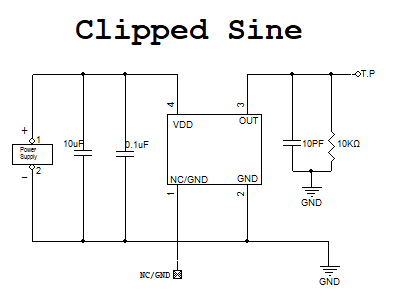
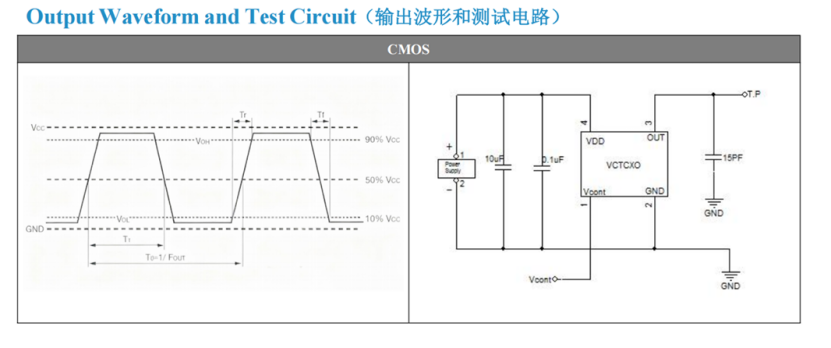
A TCXO (Temperature Compensated Crystal Oscillator) is a temperature-compensated crystal oscillator that mitigates temperature-induced frequency variations through an integrated circuit comprising thermistors and RC components. In contrast, a VC-TCXO (Voltage Controlled Temperature Compensated Crystal Oscillator) incorporates voltage control functionality, allowing external voltage regulation of the oscillator's frequency. The key distinction between VC-TCXO and TCXO lies in their voltage control capability.
|
PIN |
Connections |
|
|
VC-TCXO |
TCXO |
|
|
1 |
Vc |
OE/NC/GND |
|
2 |
GND |
|
|
3 |
OUT |
|
|
4 |
VDD |
|
Based on the compensation method, temperature-compensated crystal oscillators can be classified into two major categories.
1. Indirect Compensation Quartz Crystal Oscillator (abbreviated as: Voltage-Controlled Temperature-Correction Crystal Oscillator in Chinese, VC-TCXO in English)
The nonlinear frequency drift of quartz chips is compensated by adjusting their series capacitance. This method achieves ±0.5ppm precision but is limited at low voltages below 3V. To address this, a temperature-compensated resistor network is added to the front end of a voltage-controlled crystal oscillator (VCXO), where the output voltage of the compensation network controls the VCXO's control terminal voltage, forming a voltage-controlled temperature-compensated crystal oscillator (VC-TCXO).
2. Direct Compensation Quartz Crystal Oscillator (abbreviated as TCXO in Chinese and English)
A direct compensation TCXO (Temperature Compensated Crystal Oscillator) is a temperature compensation circuit composed of a thermistor and RC components, connected in series with a quartz crystal in the oscillator. When temperature changes occur, the resistance of the thermistor and the equivalent series capacitance of the crystal adjust accordingly, thereby compensating for or reducing the temperature drift of the oscillation frequency. Essentially, this achieves compensation by directly incorporating a temperature-sensitive RC network into the oscillator circuit's resonant path. This design eliminates the need for a VCXO and requires no voltage stabilization of the oscillator circuit, offering advantages in circuit complexity, power consumption, and size.